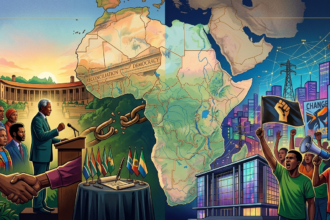


ECOWAS Commission President Dr. Omar Alieu Touray has reaffirmed the bloc’s commitment to advancing regional peace amid escalating security threats.
The President of the Economic Community of West African States (ECOWAS) Commission, Dr. Omar Alieu Touray, has delivered a resolute defense of the regional bloc’s efforts to maintain peace and security across a deeply fractured West Africa. Addressing parliamentarians, Touray asserted that despite unprecedented political and security challenges, ECOWAS remains the indispensable anchor for stability in the region.
Dr. Touray’s remarks were made during a high-level executive summary presented to the ongoing Sixth Legislature of the ECOWAS Parliament. The address comes at a critical juncture for the 15-member bloc, which is currently navigating the most severe existential crisis since its founding, marked by a cascade of military coups, democratic backsliding, and a relentless jihadist insurgency in the Sahel.
Confronting the Security and Democratic Deficit
West Africa has witnessed a dramatic democratic regression over the past five years. Several member states are currently under military junta rule, leading to complex diplomatic standoffs between the central ECOWAS leadership in Abuja and the breakaway military regimes in Mali, Burkina Faso, and Niger. These junta-led nations have actively threatened to withdraw from the bloc, challenging the fundamental architecture of regional integration.
During his address, Dr. Touray emphasized that ECOWAS is not retreating from its foundational mandate. He underscored that the Commission is actively implementing key programs designed to reinforce institutional resilience, mediate political transitions, and coordinate cross-border counter-terrorism operations. The bloc’s strategy hinges on blending diplomatic pressure with developmental support to prevent the total collapse of state authority in vulnerable border regions.
The geopolitical stakes are immense. The power vacuum created by political instability has allowed transnational terrorist organizations and organized crime syndicates to expand their territorial control, threatening coastal states that have traditionally been insulated from the violence of the Sahel.
Strategic Pillars of the ECOWAS Response
To combat the multifaceted crises, the ECOWAS Commission is advancing several critical initiatives aimed at restoring order and fostering economic continuity. The leadership recognizes that security cannot be achieved through military intervention alone; it requires deep structural economic reforms and the restoration of constitutional order.
Key focus areas outlined by the Commission include:
- The deployment of regional mediation teams to negotiate verifiable, time-bound transition timelines for countries currently governed by military authorities.
- Enhanced intelligence sharing and joint border patrols among member states to disrupt the sophisticated supply chains of insurgent groups operating across the Sahel.
- The operationalization of the ECOWAS Standby Force, intended to provide a rapid military response capability to counter unconstitutional changes of government and protect civilian populations.
- Aggressive push for economic integration, ensuring that cross-border trade and the movement of goods continue unhindered despite political friction between capital cities.
Implications Beyond West Africa
While the immediate crisis is localized in West Africa, the outcomes hold profound implications for the entire continent, including East Africa. For policymakers in Nairobi and the East African Community (EAC), the struggles of ECOWAS serve as a critical case study in the limitations and necessities of regional diplomatic intervention. The EAC is currently grappling with its own security challenges, particularly in the eastern Democratic Republic of Congo and Somalia, making the ECOWAS experience highly relevant.
Dr. Touray’s address sought to project unity and institutional endurance. He reminded the parliamentarians that the strength of ECOWAS lies in its collective economic weight and its historical ability to enforce democratic norms when member states falter. However, critics argue that the bloc’s inability to prevent the recent wave of coups points to a need for sweeping institutional reform and a departure from traditional diplomatic protocols.
The coming months will thoroughly test the Commission’s resolve. As military regimes consolidate power and flirt with alternative global alliances, including military contractors from Russia, ECOWAS must prove that its framework of regional peace, security, and economic integration offers a superior path forward for the citizens of West Africa.