

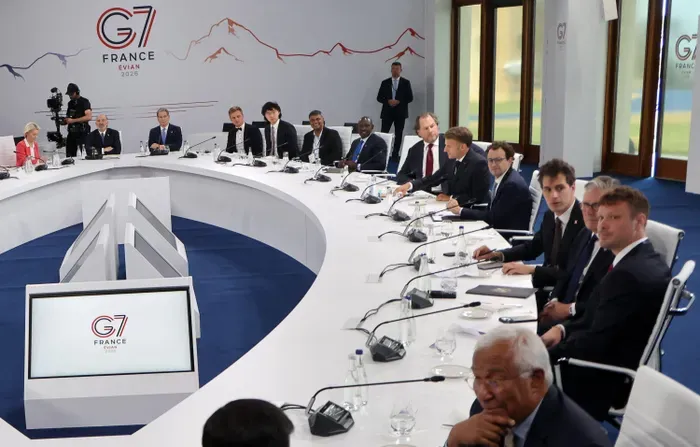
The leaders of the G7 met in Évian on 16–17 June 2026 and issued declarations on security, technology, economic growth and international cooperation.
But they failed to explicitly address one of the greatest human rights scandals of our time: child labour.
They did not explicitly address forced labour.
They did not explicitly defend the right of every child to an education.
This silence is particularly troubling because these same governments committed themselves to ending child labour in all its forms by 2025 when they adopted the Sustainable Development Goals at the United Nations in 2015.
That deadline has passed.
The world failed.
Today, according to academic estimates, nearly 400 million children are engaged in child labour. UNESCO reports that approximately 273 million children and young people are out of school.

Image: Supplied
These are not just numbers.
They are children whose childhoods have been stolen. Children whose classrooms have been replaced by fields, factories, mines, workshops and supply chains serving the global economy.
A child cannot be fully present in school while working long hours.
Child labour and the right to education cannot coexist.
Yet instead of acknowledging the missed 2025 deadline or presenting a credible plan to eliminate child labour, the G7 chose silence.
That silence stands in sharp contrast to the commitments made by G7 leaders in Elmau, Hiroshima and Puglia, where they reaffirmed their commitment to human rights and to the elimination of child labour and forced labour.
Commitments without implementation become empty promises.
The G7 countries possess enormous economic and political power. They have the ability to demand that corporations and investors eliminate child labour and forced labour from global supply chains. They have the power to defend the right of every girl and every boy to attend school instead of work.
The question is not whether they can act.
The question is whether they will.
History will not judge leaders by the communiqués they issue. It will judge whether they defended the most vulnerable.
The year 2025 was supposed to mark the end of child labour.
Instead, 2026 has become another year of broken promises.
The leaders of the G7 had an opportunity to explain how they intend to fulfil their commitment to end child labour and guarantee every child’s right to education.
They did not.
Sadly, I must also admit, as a journalist, that the top journalists covering the G7 Leaders’ Summit in Évian failed the world’s poorest children.
They didn’t ask why child labour, forced labour and the right to education were not explicitly addressed by the leaders after the world missed its own 2025 deadline to end child labour.
The media must ask them why.