
– By Chris Maroleng
I have been turning this over in my mind for weeks now, not as an abstract academic exercise, but as a citizen of a region that once dared to dream of a different future. And then my friend and respected colleague, Hopewell Chinono, posted an observation on X that crystallised everything I had been struggling to articulate.
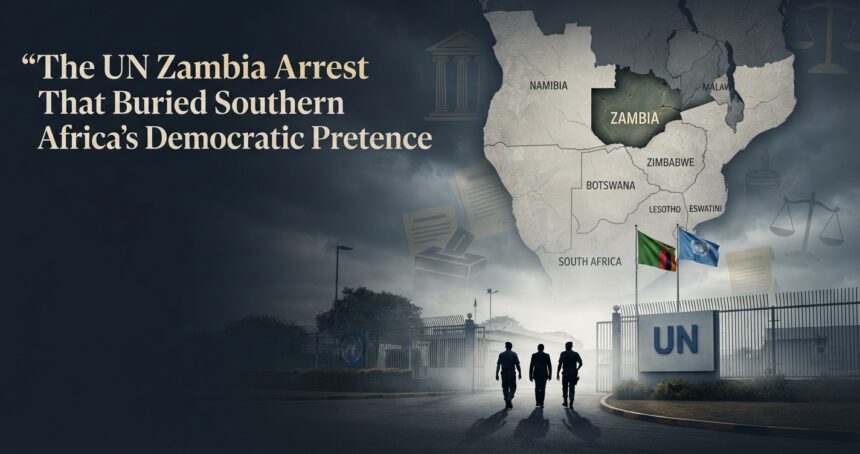
The image he shared was of Brian Mundubile, Zambia’s opposition leader, arrested inside the United Nations compound in Lusaka, which in my view is not merely a news item. It is a verdict… A verdict on how far we have fallen as a southern Africa, and how little we seem to care.
This is the moment Zambia’s opposition leader, Brian Mundubile, who has accused Zambian strongman Hakainde Hichilema of rigging the 13 August presidential election, was arrested by police alongside fellow opposition figure Makebi Zulu.
On Monday, Hichilema shut down the courts,… pic.twitter.com/kNoF5V9JJD
— Hopewell Chin’ono (@daddyhope) August 27, 2026
A Line Crossed in Lusaka
Let us be brutally honest about what transpired. Mr Mundubile did not flee to the UN compound for comfort; he fled for survival and with good reason. This is, after all, the same Lusaka in which former Zambian minister Mutotwe Kafwaya was reportedly shot dead during a security operation, and where the Rt Rev Trevor Mwamba, the retired former Anglican Bishop of Botswana, was detained without explanation. The state’s capacity for violence is no longer theoretical; it is demonstrated, documented, and increasingly normalised. Mundubile sought sanctuary in the one physical space on Zambian soil that, by international convention, ought to be inviolable. And the state, the Hakainde Hichilema regime reached into that sacred space, dragged him out, and cuffed him. This is not diplomatic clumsiness. This is a calculated, contemptuous declaration that no law, domestic or international, stands between those in power and those who dare to challenge them.
“This is not diplomatic clumsiness. This is a calculated, contemptuous declaration that no law, domestic or international, stands between those in power and those who dare to challenge them.”
And let us not sanitise the sequence: the courts were effectively shut down to prevent Mundubile from legally contesting a disputed election result. The judiciary, that fragile last bulwark against executive overreach, was practically rendered irrelevant. And with the path to justice blocked, Hichilema proceeded with his inauguration, daring the region, the continent, and the world to object. The silence that followed has been deafening, and it speaks volumes.
Southern Africa’s Emerging Democratic Divide
Hopewell’s diagnosis is precise as he went on to observe that this situation “leaves only South Africa, Botswana, Lesotho, Malawi, and Namibia as mainland Southern Africa’s remaining electoral democracies”. But I want to go further, because I believe he has stumbled upon a truth that our regional bodies like SADC, the AU, the UN, are terrified to confront. What we are witnessing is not a random cascade of democratic failures. It is the deliberate, systematic construction of a two-speed normative order within our sub-region, what you may call a normative schism that is reshaping the political geography of Southern Africa in ways we have not yet fully comprehended.
The ‘Democratic Crescent’
On one side, you have the Southern African Customs Union (SACU) states +Malawi. This is the so-called “democratic crescent”, a neo-democratic grouping that still performs the rituals of inclusive governance. Elections are held, judiciaries occasionally assert themselves, and civil society operates, however tenuously. But let us not romanticise this bloc. South Africa is mired in state capture’s lingering rot accusation of so called “Afrophobic” motivative violence and service delivery catastrophes. Botswana’s democracy is real yet ossified under a near-permanent ruling party. Malawi’s courts showed spine in 2020, but its institutions are chronically underfunded and vulnerable. This is not a beacon; it is a fragile, conditional liberalism, sustained more by donor pressure and historical accident than by genuine constitutional conviction.
The Inland Arc
But the other side, the inland arc that now includes Zambia, Zimbabwe, Mozambique, and Eswatini, has abandoned even that hollow pretence. Here, the operative logic is not democratic deepening, but stabilisation through exclusion. The elite compact is clear because central to this philosophy is that order trumps participation, security trumps rights, and the state’s monopoly on violence is deployed not against external threats, but against domestic political opposition. Courts are not abolished; they are neutered through delayed appointments, executive intimidation, and the quiet erosion of judicial independence. Parliaments become echo chambers; security forces become the party’s praetorian guard; and civil society is systematically criminalised through legislation, cybercrime laws, NGO restrictions, and the weaponisation of tax authorities.
“Order trumps participation, security trumps rights.”
What Hopewell has inadvertently exposed, and I say this with the utmost respect for his insight, is the unstated establishment of an alternative normative and values base in inland Southern Africa. One characterised by narrowing democratic space, the routine use of state violence, and an elite consensus that views political opposition not as a legitimate check on power, but as an existential enemy to be neutralised. The arrest at the UN compound is not an outlier, it is the logical, inevitable endpoint of this philosophy.
Can Regional Integration Survive a Values Divide?
And here is the hard question that keeps me awake at night: Is regional integration compatible with such normative divergence? Because SADC and SACU were not built as mere trade blocs; they were founded on the assumption of convergent values, that the belief that shared prosperity requires shared principles of governance. If Zambia now normalises the use of state power to crush dissent, if it criminalises the very idea of opposition, then what is the point of our regional architecture? Are we simply going to sit in Gaborone or Pretoria and pretend that what happens in Lusaka does not affect us? Because it does. It affects us profoundly.
The Contagion of Illiberalism
The contagion of illiberalism does not respect borders. When one state demonstrates that you can arrest an opponent at the UN compound without consequence, every other state in the region takes note. The message is clear: the international community will tut, issue a mild statement, and move on. The deterrent effect of regional norms evaporates. And then we wonder why civil society is shrinking, why journalists are self-censoring, why young people are fleeing this continent in droves.
A Collective Failure of Southern African Leadership
Let me be unequivocal: this is not about Zambia alone. This is about the collective failure of Southern African leadership, political, diplomatic, and civic, to defend the principles we claim to cherish. Where is the SADC Tribunal? Rendered impotent. Where is the AU’s assertive voice? Muted by diplomatic protocol. Where is the UN’s swift condemnation? Buried in procedural niceties. We have allowed the normative fabric of our region to be torn apart, and we have done so with the quiet acquiescence of those who should know better.
“We have allowed the normative fabric of our region to be torn apart, and we have done so with the quiet acquiescence of those who should know better.”
The Crisis Hopewell Chinono Named
Hopewell, with a single tweet, has done what our regional bodies have failed to do: he has named the crisis. He has forced us to confront the uncomfortable truth that Southern Africa is not transitioning towards democracy, but between different models of governance, a pluralism of illiberalisms, each competing for legitimacy and influence. The question is no longer whether elections are free and fair; the question is whether the state permits the idea of opposition to exist at all. In Lusaka, that idea was physically cornered. In Harare, it is routinely tortured. In Maputo, it is bought off or broken, recently in Dar es Salaam it was brutally shot down.
The Remaining Democratic Space
And what of the remaining five we have opted to call the SACU + Malawi? South Africa, Botswana, Lesotho, Malawi, and Namibia must recognise that their own democratic spaces are not immune. The forces that drive intolerance, economic inequality, elite capture, youth unemployment, are present in all our countries. The difference is that, for now, we still have the institutional space to contest, to protest, and to hold power to account. But that space is not guaranteed; it is earned daily through vigilance, through the courage of judges, journalists, and ordinary citizens who refuse to be silenced.
A Region That Chose Silence Over Solidarity
I have been thinking about this a great deal, not as an analyst detached from reality, but as someone who has witnessed the slow strangulation of democratic possibility across this region. And I am grateful to Hopewell for reminding us that sometimes, the most devastating analysis begins with a single, unflinching image: a man arrested at the United Nations, a democracy buried in plain sight, and a region that has chosen silence over solidarity.
The arrest at the UN compound is not just Zambia’s shame. It is ours. All of ours. And until we name it as such, until we demand accountability not from Lusaka alone, but from Pretoria, Gaborone, Windhoek, Maseru and Lilongwe, we will continue to watch our democratic inheritance erode, one arrest, one court closure, one stolen election at a time.
We have a choice. We can continue to observe, analyse, and lament from the safety of our institutions. Or we can recognise that the mirror held up in Lusaka reflects all of us and that the time for diplomatic euphemisms has long passed.
I choose to speak plainly. I choose to name the rot. And I choose to thank Hopewell Chinono for inspiring us with the guts to do so.
Chris Maroleng is a political analyst and commentator on Southern African affairs. The views expressed in this article are his own.