
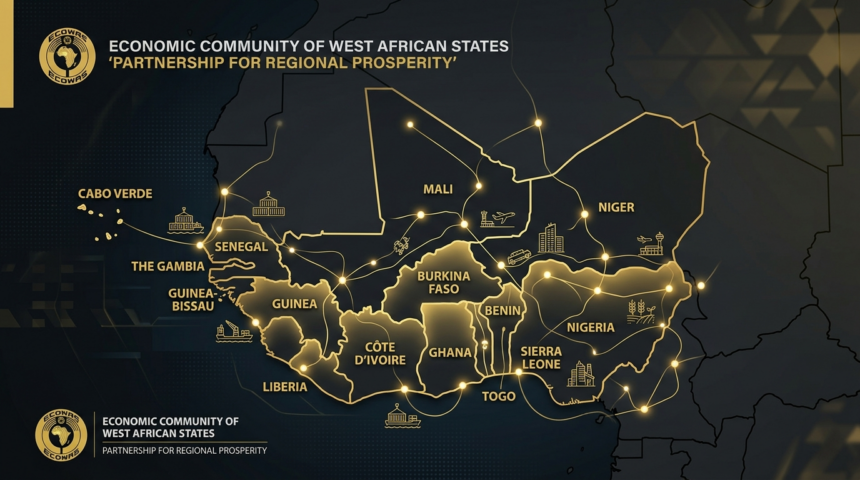
The Economic Community of West African States (ECOWAS) is one of Africa’s most ambitious regional blocs, built on the idea that economic integration, political cooperation, and collective security can transform a diverse group of countries into a more stable and prosperous region.
What is ECOWAS?
ECOWAS is a regional political and economic union of 15 West African countries, founded in 1975 through the Treaty of Lagos with the aim of promoting cooperation and integration, ultimately creating a single economic space across West Africa.
Over time, ECOWAS has evolved beyond trade. Today, it plays a central role in:
- Conflict prevention and peacekeeping
- Democratic governance and election monitoring
- Regional infrastructure and development
- Free movement of people and goods
Member States
ECOWAS brings together a mix of anglophone, francophone, and lusophone countries: Benin, Burkina Faso, Cabo Verde, Côte d’Ivoire, The Gambia, Ghana, Guinea, Guinea-Bissau, Liberia, Mali, Niger, Nigeria, Senegal, Sierra Leone, and Togo.
This linguistic and cultural diversity is both a strength and a challenge, requiring constant negotiation and coordination.
Why ECOWAS Matters
- Economic integration
At its core, ECOWAS is about building a regional economy. It promotes:
- A free trade area (with reduced tariffs between member states)
- Plans for a common currency (the proposed “Eco”)
- Regional infrastructure projects in transport, energy, and telecommunications
For a region where many economies are relatively small on their own, integration creates scale, attracts investment, and improves competitiveness.
- Free movement of people
One of ECOWAS’s most tangible successes is its protocol on free movement. Citizens of member states can:
- Travel visa-free within the region
- Live and work in other member countries (with some limitations in practice)
This has enabled trade, migration, and cultural exchange across borders in ways few African regions have matched.
- Peace and security role
ECOWAS has developed a reputation as a regional security actor. It has intervened in conflicts and political crises in countries such as Liberia, Sierra Leone, and The Gambia.
Through mechanisms like ECOMOG (its military intervention force), ECOWAS has attempted to:
- Prevent civil wars from spilling across borders
- Restore constitutional order after coups
- Stabilise fragile states
- Democratic norms
ECOWAS has positioned itself as a defender of constitutional governance. It has protocols that:
- Reject unconstitutional changes of government
- Enable sanctions against coup regimes
- Support election observation missions
This has made ECOWAS a key player in shaping political norms in West Africa.
Key institutions
ECOWAS operates through several core bodies:
- Authority of Heads of State and Government – the highest decision-making body
- ECOWAS Commission – the executive arm responsible for implementation
- ECOWAS Parliament – a consultative body representing citizens
- ECOWAS Court of Justice – adjudicates disputes and human rights cases
- ECOWAS Bank for Investment and Development (EBID) – finances regional projects
Current challenges
Despite its ambitions, ECOWAS faces significant pressure:
- Political instability and coups
Recent military takeovers in countries like Mali, Burkina Faso, and Niger have strained the bloc. These crises test ECOWAS’s commitment to democracy versus its ability to maintain unity. - Security threats
The Sahel region faces growing threats from extremist groups, which spill across borders and stretch regional cooperation. - Economic fragmentation
While trade barriers have been reduced, non-tariff barriers, infrastructure gaps, and currency differences still limit full integration. - Credibility and public perception
ECOWAS is sometimes criticised as being slow, inconsistent, or overly influenced by dominant states.
ECOWAS In The African Context
ECOWAS is often seen as one of Africa’s most advanced regional blocs and plays a key role in the African Union’s broader vision, including Agenda 2063, which calls for a united, integrated, and prosperous continent.
Its successes and failures offer important lessons:
- Integration requires political will, not just treaties
- Regional stability is essential for economic growth
- Public trust matters as much as institutional design
Fast facts
- Founded: 1975 (Treaty of Lagos)
- Members: 15 countries
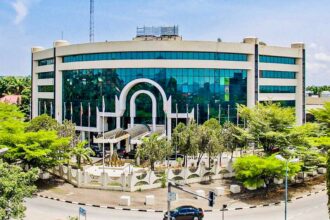
- Headquarters: Abuja, Nigeria
- Population (combined): Over 400 million people
- Key ambition: A single regional market, and eventually a common currency
The bigger picture
ECOWAS is much more than simply a regional body. In a global economy shaped by large, integrated markets, regional blocs like ECOWAS provide a pathway for African countries to build resilience, amplify their voice, and drive development on their own terms.
Its trajectory – towards unity or fragmentation – will have implications far beyond West Africa. – Africa360News