
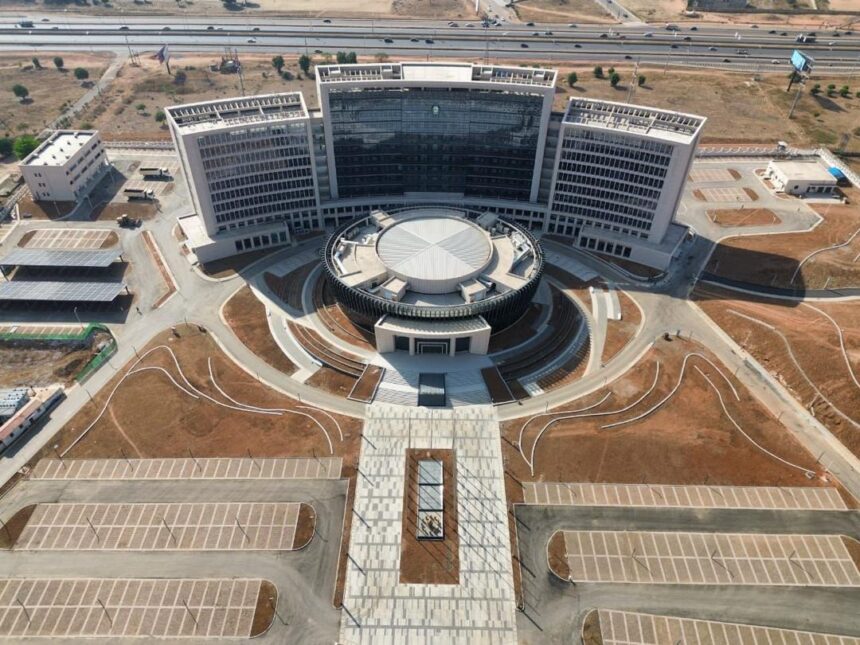
On a rain-washed morning in Abuja, the handover of a building unfolded as something far bigger than ceremony. The new headquarters of the Economic Community of West African States now stands as a physical symbol of regional ambition, global partnership, and the evolving politics of West Africa. Already described as the “Eye of West Africa,” it is, in the words of China’s ambassador Yu Dunhai, “a milestone… China’s flagship aid project for ECOWAS.”
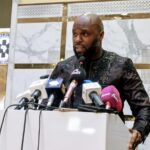
For ECOWAS Commission President Omar Alieu Touray, the moment carried both celebration and caution. “Today marks an important day for ECOWAS,” he said, placing the event firmly within the bloc’s 50-year journey of integration. Yet he was careful not to overstate completion as conclusion. “This event only marks the project completion and handover of the buildings,” he noted, adding that formal commissioning will follow later in the year. Even so, he described the structure as “a fitting instrument to drive the regional integration process, fostering enhanced peace and prosperity for all ECOWAS citizens.”
That idea—that the building is a tool rather than just a symbol—ran through the ceremony. Nigeria’s Minister of State for Foreign Affairs, Bianca Odumegwu-Ojukwu, put it more broadly, saying the moment “transcends the commissioning of a physical structure.” It represents, she said, “the consolidation of a vision, a reaffirmation of unity, and a renewed commitment to the ideals of regional integration, peace, and sustainable development.” For her, ECOWAS itself remains “a beacon of cooperation and solidarity,” active in everything from peacekeeping to democratic governance across West Africa.

That sense of responsibility was central to her message. “The strength of ECOWAS lies not merely in its institutions, but in the unity, commitment, and collective resolve of its Member States,” she warned. In a region facing security pressures, political transitions, and economic strain, she stressed, “our unity is not optional, it is imperative.”
The host nation also used the occasion to reinforce Abuja’s role as a diplomatic hub. Federal Capital Territory Minister Nyesom Wike represented by the Minister of State for FCT, Mariya Mahmoud Bunkure, described the headquarters as more than infrastructure. “Today is not just about the handover of a building… it is the handover of a vision—a vision of partnership, a vision of regional solidarity.” He went further: “This magnificent edifice is more than concrete, steel, and glass. It is a statement that cooperation still matters.” For him, Abuja is central to that story: “Abuja is not only the seat of government; it is the diplomatic capital of this nation—a meeting point of nations.”
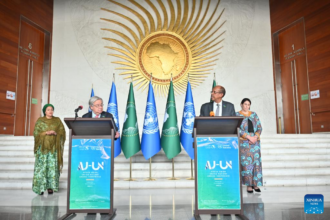
If ECOWAS and Nigeria framed the building as institutional and political strengthening, China framed it as strategic partnership and long-term engagement. Ambassador Yu Dunhai described it as “China’s flagship aid project for ECOWAS,” and placed it in a broader continental context alongside the African Union headquarters in Addis Ababa. Built over what he called “more than 1,200 days and nights of meticulous craftsmanship,” the structure, he said, has been transformed from “a visionary blueprint into a concrete reality.”
Yu emphasised not just construction, but design philosophy: the building, he said, “harmonizes the excellence of Chinese architectural technique with the unique culture of West Africa,” and will “substantially enhance the operational capacity of the ECOWAS Commission.” But his remarks went beyond infrastructure into ideology and global positioning. China, he said, rejects “a return to the ‘law of the jungle’” and instead supports “an equal and orderly multi-polar world.” Cooperation, he insisted, is guided by “non-interference, no political strings attached, and a rejection of ‘empty promises.’” And in a line that captured the symbolism of the day, he concluded: “One building carries shared hopes and one partnership writes a legacy.”

The scale of China’s engagement in Africa gives that statement context. Across the continent, Chinese-backed projects have delivered over 10,000 kilometres of railways, nearly 100,000 kilometres of roads, and hundreds of bridges and ports, alongside billions in infrastructure financing. In Nigeria alone, Chinese partnerships have shaped major transport and energy projects. But the ECOWAS headquarters represents something different—it is not economic infrastructure, but institutional infrastructure, the space where regional governance itself will be coordinated.
That distinction matters because of timing. West Africa is navigating a period of political uncertainty, security challenges in parts of the Sahel, and questions about the cohesion of ECOWAS itself. The building, therefore, arrives as both opportunity and pressure. Wike captured that tension bluntly: “At a time when our sub-region faces serious tests, this building rises as a reminder that West Africa must never surrender to division.” Touray, too, looked forward rather than back, saying: “We pledge to create an even greater legacy for those who will follow us.”
Across the speeches, the language of legacy kept returning. Touray spoke of “the legacy of our founding fathers.” Wike said “history will always remember those who build.” Odumegwu-Ojukwu described the moment as “not an end, but a new beginning.” And Yu tied it all together with a simple framing: “One building carries shared hopes.”
In the end, the “Eye of West Africa” stands at the intersection of ambition and expectation. It reflects ECOWAS’ attempt to strengthen its institutional capacity, Nigeria’s push to anchor itself as a regional diplomatic hub, and China’s expanding role in shaping Africa’s infrastructure—and increasingly, its institutions.
But as every speaker acknowledged in different language, the building itself is not the story’s conclusion. It is the beginning of a test: whether West Africa’s most important regional institution can now match its physical scale with political effectiveness.
The structure is ready all thanks to China, but the expectations are higher than ever.