
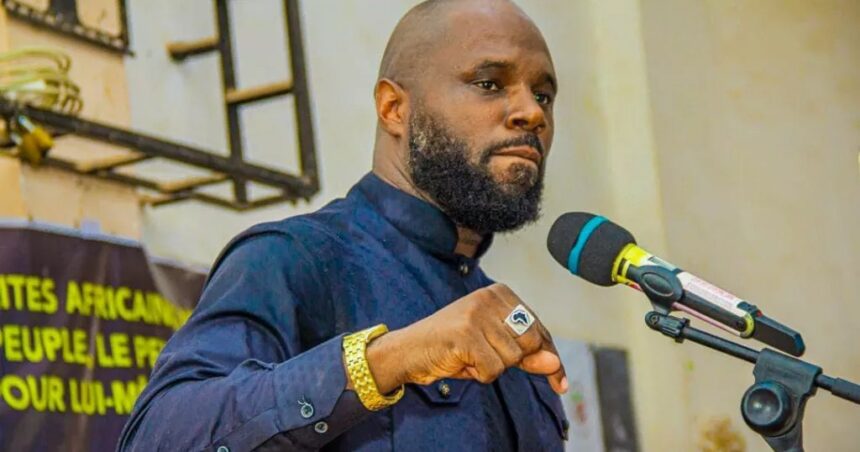
Kémi Séba’s second prison letter is not merely a declaration of political resistance. It is also a carefully constructed attempt to shift public attention away from the serious allegations before the courts and toward a familiar revolutionary mythology in which he positions himself as the persecuted defender of Black liberation against a vast neo-colonial conspiracy.
The problem is not that Séba speaks about colonialism, African sovereignty, or Western influence. These are legitimate political questions with deep historical roots and ongoing relevance across the continent. The problem is that he increasingly uses these themes as a shield against scrutiny, accountability, and lawful interrogation of alleged criminal conduct.
At no point in the letter does Séba meaningfully engage with the specific legal questions surrounding his arrest, extradition proceedings, or the allegations presented against him in court. Instead, he substitutes evidence with emotional grandstanding, political absolutism, and apocalyptic rhetoric. This is not political clarity. It is political theatre.
The manufacture of martyrdom
One of the central devices in Séba’s letter is the construction of martyrdom.
He repeatedly argues that his detention proves the legitimacy of his political struggle: “If you claim to fight a system and it in return does not attack you, it means you are not bothering it.”
This is rhetorically powerful, but logically flawed.
History is full of political activists who were unjustly persecuted by oppressive systems – as South Africans know all too well. But history is also full of individuals who used political language to mask criminality, manipulation, corruption, or opportunism. Being investigated, arrested, or prosecuted does not automatically transform someone into a revolutionary martyr.
The dangerous implication in Séba’s argument is that any legal action against him becomes proof of his righteousness. Under that logic, no allegation could ever be legitimate because the accusation itself becomes evidence of conspiracy.
That is not resistance politics. It is ideological immunisation from accountability.
A genuine political leader welcomes scrutiny because truth strengthens credibility. A demagogue treats scrutiny itself as proof of persecution.
Political hyperbole as a diversion strategy
Throughout the letter, Séba avoids specifics and instead relies on escalating emotional language:
- “pro-French mafia”
- “neo-colonial elite”
- “black traitors”
- “white South African secret agents”
- “rats”
- “criminals”
- “voluntary Beninese slaves”
This language serves an important political function: it transforms a legal matter into a civilisational war.
Once that transformation occurs, supporters are no longer encouraged to ask factual questions. They are encouraged to choose sides emotionally. Anyone questioning the allegations risks being labelled a collaborator, traitor, or servant of colonialism.
This tactic is not unique to Séba. Around the world, populist figures facing legal jeopardy often attempt to merge themselves with a broader political cause:
- criticism becomes oppression;
- investigation becomes persecution;
- legal process becomes colonial warfare.
The individual is then elevated beyond accountability because questioning them is framed as questioning the struggle itself.
But pan-Africanism cannot survive if it becomes dependent on personality cults rather than principles.
The weaponisation of black liberation
Perhaps the most troubling aspect of the letter is the repeated invocation of “the Black people” as though Séba alone embodies their aspirations. “No one will stop our fight for the Black people,” he declares.
But who appointed him the singular custodian of black liberation?
African political history teaches painful lessons about leaders who fused themselves with the destiny of the people until disagreement became treason. Liberation rhetoric can become dangerous when it turns into political absolutism.
To claim to represent black people while dismissing all critics as colonial agents is intellectually dishonest and politically reckless.
Black political thought is diverse. Africans are capable of supporting anti-colonial ideas while still demanding:
- transparency;
- ethical conduct;
- legal accountability;
- democratic engagement; and,
- evidence-based politics.
The reduction of all disagreement into betrayal weakens African political culture instead of strengthening it.
The contradiction at the heart of the letter
Séba insists he fears no one except God and claims complete serenity. Yet the letter itself is saturated with anger, paranoia, and escalating hostility.
If he is truly unconcerned, why the need for constant enemies?
Why the need to describe opponents as “rats”, “cockroaches”(a familiar refrain used in Rwanda in 1994), and “slaves”?
Why the need to invoke death repeatedly?
The contradiction matters because revolutionary language loses moral credibility when it descends into dehumanisation.
African liberation movements historically derived legitimacy not only from resistance, but from moral vision. Leaders such as Patrice Lumumba, Thomas Sankara, Nelson Mandela, Steve Biko, Amílcar Cabral, and Julius Nyerere articulated political opposition without relying on perpetual conspiratorial rage.
Séba increasingly speaks less like a political educator and more like a man constructing an existential battlefield in which he alone stands between Africa and total subjugation.
That is not pan-Africanism. It is messianic populism.
The silence around the actual allegations
Most notably, the letter avoids substantive engagement with the core legal issues surrounding the case.
There is no detailed rebuttal.
No presentation of evidence.
No explanation of inconsistencies.
No transparent engagement with the prosecution’s claims.
Instead, supporters are asked to interpret the case emotionally:
“If they target me, I must be important.”
“If governments oppose me, I must be telling the truth.”
But political seriousness requires more than emotional mobilisation.
If Séba believes the charges are politically motivated, then the strongest response would be:
- rigorous factual rebuttal;
- transparent legal argument;
- documentary evidence; and
- procedural challenge through the courts.
Instead, the public receives mythology.
The danger of revolutionary narcissism
Another recurring theme in the letter is the idea that history revolves around Séba himself.
He frames the conflict as global:
- France,
- Benin,
- South African intelligence,
- neo-colonial elites,
- Western systems.
Everyone appears mobilised against him because of his importance.
This kind of political self-magnification is common among charismatic populists. The leader becomes central to history itself. Every event becomes part of a grand conspiracy validating their significance.
But liberation movements collapse when institutions become subordinate to personalities.
The African continent does not need more political saviors. It needs stronger institutions, ethical leadership, democratic accountability, economic transformation, and intellectual honesty.
Anti-colonialism cannot mean anti-accountability
One of the greatest dangers facing contemporary African politics is the misuse of anti-colonial language to evade accountability.
Colonialism was real.
Neo-colonial economic structures remain real.
Western geopolitical interference exists.
But these truths cannot become universal excuses that silence every legal or ethical question directed at politically connected figures.
Otherwise, anti-colonialism ceases to be a philosophy of liberation and becomes a permanent immunity doctrine for charismatic actors.
African societies deserve better than binary choices between Western domination and personality-driven radicalism.
A serious political question remains
The deeper issue raised by Séba’s letter is not whether Africa should resist neo-colonial influence. It should.
The real question is this:
Can African political movements build credible liberation projects rooted in transparency, democratic ethics, intellectual discipline, and accountability – or will they continue producing figures who transform every challenge into a spectacle of persecution and revolutionary mythology?
Because ultimately, the future of Pan-Africanism cannot rest on outrage alone.
It must rest on truth.
And truth requires scrutiny, not just slogans.