




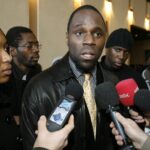
Kémi Séba’s arrest in South Africa and his possible extradition to Benin are not just another legal story. It is a mirror held up to a deeper African dilemma: where does legitimate criticism end, and where does dangerous misinformation begin? And who gets to decide?
The charges against him are not trivial. Beninese authorities accuse Séba of inciting rebellion after he publicly supported a failed coup attempt in December 2025. He is no marginal voice either, but a seasoned political activist, influential in pan-African circles, known for his fierce anti-Western rhetoric (particularly French) and for supporting military regimes in parts of West Africa. That combination of reach, ideology, and timing makes this case far more than a matter of individual speech.

Criticism vs Misinformation: A Line Often Blurred on Purpose
Criticism of power, especially in post-colonial African states, is not only legitimate but necessary. Séba has built much of his following on attacking what he frames as neo-colonial influence, particularly France’s historic and ongoing role in West Africa. That critique resonates because the CFA franc debate, foreign military presence, and uneven economic relationships are real, contested issues.
But criticism becomes something else when it detaches from fact and consequence.
Supporting or legitimising a coup, especially in a region already destabilised by a wave of military takeovers, is not merely dissent. It is an intervention in a volatile political ecosystem. According to news reports, Séba described the attempted overthrow in Benin as a moment of “liberation”. That is not simply commentary but a narrative framing with potential real-world impact.
Misinformation does not always look like false data. Sometimes it is selective truth, amplified emotion, and ideological certainty packaged for mass consumption.
Free Speech vs “Shouting Fire in A Crowded Market”
The familiar metaphor free speech does not include shouting fire in a crowded theatre feels like an old and outdated idiom until you place it in West Africa’s current context.
The region is living through a period of acute instability. Since 2020, multiple coups have taken place across the Sahel. Ecowas (the Economic Community of West African States), once seen as a stabilising force, is under strain. Borders have closed, alliances have fractured, and external actors – from Russia to former colonial powers – are competing for influence.
In that environment, speech is not just speech.
When a high-profile figure endorses unconstitutional change, it can:
- Legitimise military actors seeking power,
- Erode already fragile public trust in democratic institutions,
- And inflame cross-border political tensions.
This is where the “crowded market” becomes a more fitting metaphor than a theatre. West Africa’s political space is dense, interconnected, and combustible. Words travel fast, and they do not remain theoretical for long.
Yet the answer cannot simply be to criminalise dissent.
Because the inverse danger is just as real: governments labelling all opposition as “incitement” or “misinformation” to silence critics. Africa has a long history of that tactic. The line must exist, but it must also be credible.
The Benin Paradox
Benin has, until recently, been considered one of West Africa’s more stable democracies. But even there, concerns have grown about political space narrowing under President Patrice Talon.
This is where the nuance becomes uncomfortable.
If Séba is genuinely inciting rebellion, the state has a responsibility to act. No country can allow open advocacy for unconstitutional power grabs without consequence.
But if the prosecution is perceived as politically motivated, it risks reinforcing Séba’s own narrative that African governments aligned with external powers suppress “true” pan-African voices.
And that is where misinformation feeds on repression.
Regional Stability vs Ideological Insurgency
Séba represents a broader phenomenon, not just an individual case. He sits at the intersection of several powerful currents:
- Anti-colonial sentiment,
- Rising distrust of Western influence,
- And a growing tolerance for military strongmen in parts of the region.
He has also been linked to pro-Russian narratives and alliances with Sahelian juntas, which complicates the picture further. This is no longer just about speech, it is about geopolitical positioning.
West Africa is not only battling coups. It is battling competing stories about what legitimacy looks like.
Is it electoral democracy, however imperfect? Or is it “sovereign defiance,” even when it comes via military rule?
Figures like Séba thrive in that ambiguity.
The Uncomfortable Conclusion
It would be easy to reduce this case to binaries:
- Free speech vs repression,
- Patriot vs agitator,
- Truth vs propaganda.
But the reality is messier.
Séba has the right to critique power. That right must be protected. But he does not have the right to destabilise a state under the guise of critique.
At the same time, Benin – and any state across the region – must recognise that legitimacy is not enforced through courts alone. It is earned through openness, accountability, and trust.
Because when citizens stop believing in institutions, they start believing in voices like Séba.
And that is when criticism turns into something far more dangerous than misinformation: it becomes a competing system of truth.




Who is kemi seba?
Thank you for your comment. Read details about Kemi here: https://african360news.com/kemi-seba-case-explained-expert-insight-on-africas-stability-debate/